For a scientist with a genuine discovery, the most dangerous moment is often the quietest one. It is the conversation with a potential partner before anything is protected, the paper submitted before a filing, the year spent perfecting a prototype while the idea sits exposed. A breakthrough that is not protected is not yet a venture. At the 2026 FAS Biocamp, Jurgen Figys spent an evening teaching the cohort how to keep the two from drifting apart.
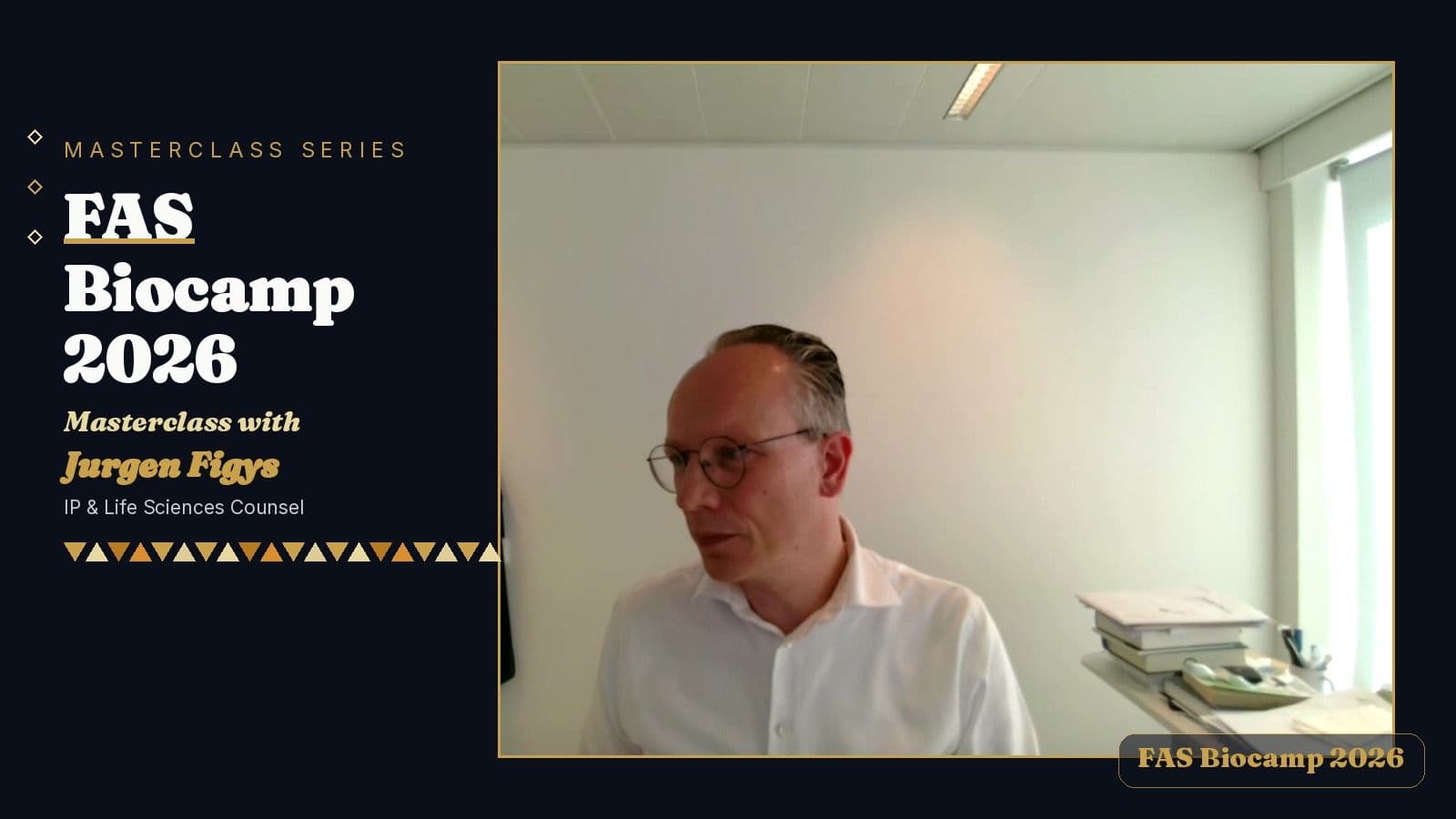
Figys came to the founders as both a scientist and a lawyer, a rare combination, and he treated intellectual property not as paperwork to file once the science is done, but as a strategy to build alongside it.
Jurgen Figys is counsel in the Brussels office of the international law firm Crowell & Moring, where he is part of the intellectual property group and works mostly with pharmaceutical and biotechnology companies. He is one of the few lawyers in Belgium who was first trained as a scientist. Before he practised law, he spent a decade at the Free University of Brussels, completing a doctorate and directing scientific studies on cell metabolism, apoptosis, and cancer physiology. That background lets him read a patent and the biology behind it at the same time. Today his work runs from patent litigation and freedom-to-operate analysis to regulatory strategy, and he teaches a course on patent enforcement to biomedical students at the University of Antwerp.
Across the session, Figys kept returning to one reframing. Intellectual property is not a legal formality to handle after the science is finished. It is part of the commercial strategy of the company, and it should be built from the beginning. Patents, partnerships, regulatory pathways, and market access are not separate workstreams. They move together, and the decisions a founder makes early about protecting an idea shape every option that comes later.
He was practical about how founders protect an early idea. Keep the invention confidential until the right application has been filed, he told them, because a discovery discussed too freely can lose its protection before it ever has it. File early, even when the technology is still messy, rather than waiting for a prototype to feel perfect. And seek professional advice at the start, when it is cheap to get the strategy right, rather than at the end, when it is expensive to fix.
He was just as honest about the limits of a patent. A patent, he reminded the cohort, is only as valuable as the founder’s willingness and ability to enforce it. In many African markets, where litigation is slow and costly, a well-kept trade secret or a defensive publication can sometimes protect a venture more practically than an expensive filing that no one has the resources to defend. The right answer depends on the venture, and choosing it deliberately is the point.
And he pushed the founders to see intellectual property as more than a wall. A patent is a negotiation tool and a signal of seriousness, an asset a young company can use to attract partners and investment, not only a shield to keep competitors out. Protected well and early, an idea becomes something a founder can build on.

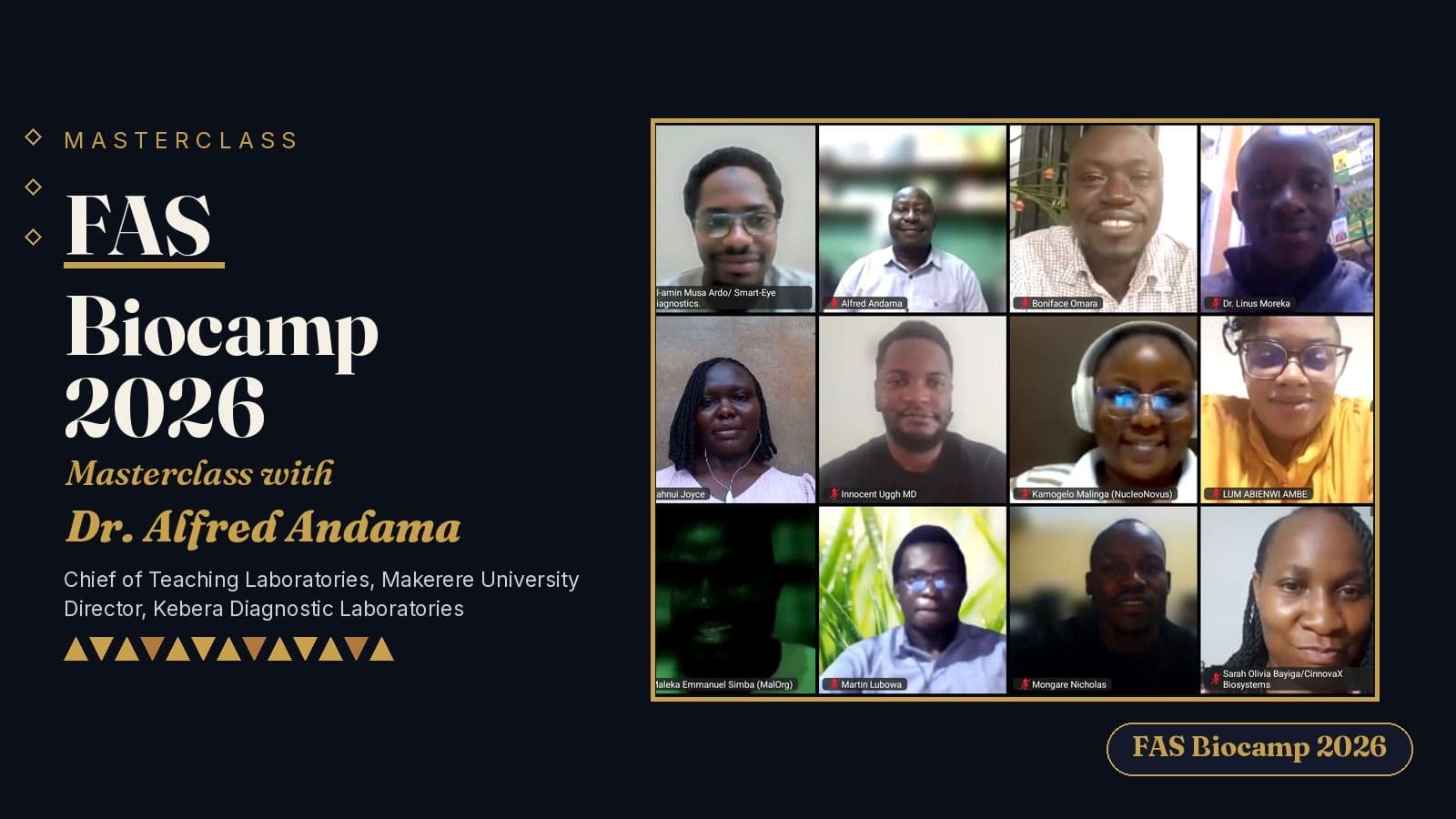
The 2026 FAS Biocamp cohort during Jurgen Figys’s 23 June masterclass on protecting innovation.
For the founders, that reframing changed the work in front of them. “I had been treating IP as a defensive moat,” said Rozy Abiero, a 2026 Biocamp founder from Kenya. “He made me see it as an asset I can use to build partnerships, not just a shield. That changes how I think about filing strategy.”
The realism about enforcement landed just as hard. “A patent is only as valuable as your willingness to enforce it,” said Sarah Bayiga, a founder from Uganda building CinnovaX Biosystems, recalling the lesson she carried away. “In Africa, where litigation is expensive, a trade secret or a defensive publication can be more practical than a costly patent filing. I will take that into account as I shape CinnovaX’s IP strategy.”
For others it dislodged a habit of waiting. “His point about filing early, even when the technology is still messy, was a wake-up call,” said Kamogelo Malinga, a founder from South Africa building NucleoNovus. “I had been waiting until everything was perfect before thinking about patents. Protecting the core innovation early is what gives room to iterate later.”
That is the discipline the FAS Biocamp is built to teach. A discovery made in an African lab should not have to leave home, or lose its edge, to become a company. It becomes one when founders protect the idea as carefully as they pursue it, and build the venture and its defences together, from the very first day.