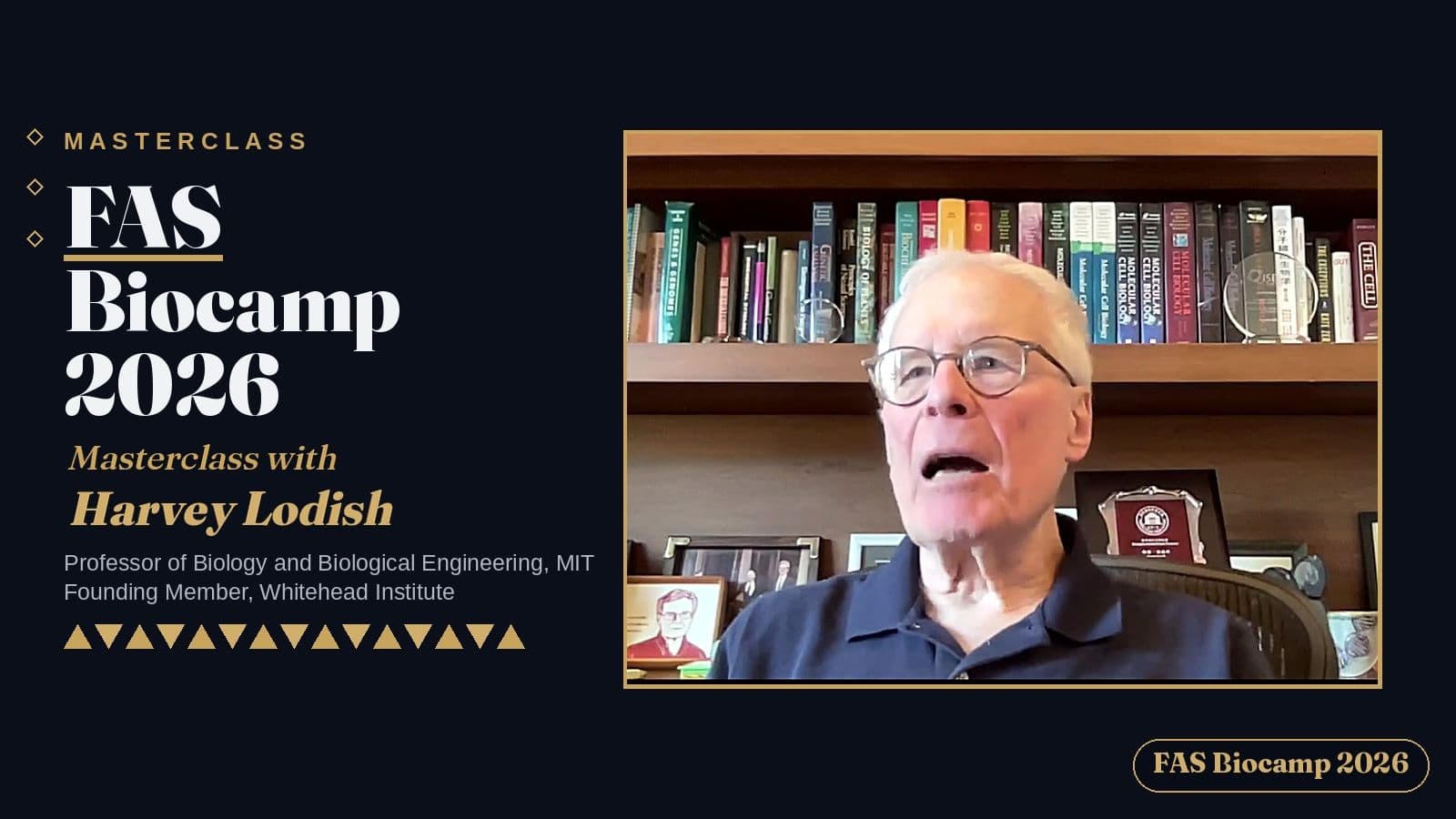
A scientific discovery, on its own, cures no one. It sits in a notebook, or a published paper, or a freezer, until someone does the far harder work of turning it into something a patient can actually receive. For the founders at the 2026 FAS Biocamp, that gap between a real result and a real therapy is the whole challenge. Over ten lectures spread across two months, Harvey Lodish walked them across it, using the story of modern biotechnology itself as the map.
Few people alive are better placed to draw that map. Lodish helped write the textbook that trained a generation of molecular biologists, and he has spent more than half a century turning fundamental biology into companies and medicines. So when he told the founders that strong science is only the beginning, he was not offering encouragement. He was describing a career built on finishing the job.
Harvey Lodish is a founding member of the Whitehead Institute for Biomedical Research and a professor of biology and biological engineering at MIT, where he has taught since 1968. He earned his doctorate in genetics from Rockefeller University and trained as a postdoctoral fellow with Francis Crick and Sydney Brenner at the MRC Laboratory of Molecular Biology in Cambridge. His laboratory pioneered the cloning of the mammalian glucose transporters and, in 1988, the gene for the erythropoietin receptor, work that reshaped how the field understands red blood cell biology and metabolism. He is the lead author of Molecular Cell Biology, now in its ninth edition and translated into a dozen languages, and he has trained more than two hundred graduate students and postdoctoral fellows, among them two Nobel laureates. Beyond the bench, he has been a founder or scientific adviser to fourteen biotechnology companies, including Genzyme, Millennium Pharmaceuticals, and Rubius Therapeutics, and he is a member of the U.S. National Academy of Sciences.

Professor Harvey Lodish (top row, highlighted) joining the 2026 FAS Biocamp cohort from his study during his masterclass lecture series.
He opened where the industry itself began, with recombinant therapeutic proteins. For most of medical history a protein drug had to be extracted from tissue or blood, in short supply and never quite pure. Learning to manufacture a human protein inside living cells changed that overnight, and it gave patients reliable insulin, growth hormone, clotting factors, and the erythropoietin that treats anemia. That first act, Lodish explained, is the template for everything that followed: a piece of basic biology, understood well enough, becomes a product that can be made at scale.
From there he laid out the modern toolkit, one modality at a time. He walked the founders through chemically modified synthetic oligonucleotides, short pieces of engineered nucleic acid that can silence or correct the instructions a cell is reading. He turned to gene therapy delivered by adeno-associated viruses, where a working copy of a gene is carried into the body to do what a broken one cannot. And he spent two sessions on monoclonal antibodies, first on how these exquisitely specific molecules became a class of medicine in their own right, then on how they are engineered, reshaped and refined to hit their target more precisely and safely.
The later lectures pushed to the frontier of the field. He examined the ex vivo gene therapies now reaching patients with sickle cell disease and beta-thalassemia, where a person's own blood stem cells are corrected outside the body and returned. He looked closely at vaccines, tracing how a modern messenger-RNA vaccine moved from studies in nonhuman primates to a completed efficacy trial. He introduced PROTACs, a new class of small molecules that do not block a disease-causing protein so much as tag it for the cell's own disposal machinery to destroy. And he discussed molecular glues, exemplified by the new drug that binds to the activated conformation of the Ras protein and that has proven effective in treating pancreatic cancer. And he closed the science with cell therapies: generating functional pancreatic islet and heart cells from Induced Pluripotent (iPS) stem cells, and CAR-T cells, T cells genetically reprogrammed to treat cancers and calm autoimmune disease.
For the final session he turned from the science to the enterprise, telling the founders the founding stories of two of his own companies, Tevard and Orthrus. Across all ten lectures a single discipline kept surfacing. Chase the problems that can be manufactured, scaled and delivered, not only the ones that publish well. Design the experiment that could disprove you fastest, and run it first. Build a platform that outlives any single product. It was, in effect, a working answer to the question every founder in the room is living: how does a discovery become a company that reaches a patient?
He was just as direct about who builds those companies. A breakthrough result does not become a business on its own, he told the founders, and the right team pairs deep scientific expertise with experienced business people who have built and run companies before. Walking through how his own ventures were assembled, he pointed to management teams that combined working scientists with seasoned operators drawn from across the industry. For founders used to carrying everything themselves, the message was freeing and demanding at once. Hire for the experience you do not have, and treat building the team as seriously as building the technology.

The 2026 FAS Biocamp cohort during Harvey Lodish's lecture series on how modern biology becomes medicine.
For the founders, the lasting lesson was often about rigor rather than ambition. “What stayed with me most was your framing of the killer experiment, designing the single test that would disprove your hypothesis fastest if it were wrong,” said Norleen Rumbidzai Jambaya, a founder from Zimbabwe. “It shifted how I approach our venture. Instead of trying to prove we are right with slow, incremental data, I am now focused on finding the fastest way to be proven wrong. It has made our lab work leaner and our decisions quicker, and it has saved us from sinking time into dead ends. Your ability to connect fundamental cell biology to real product risk is rare, and it gave me a clearer lens for building something that can actually work.”
Others heard a lesson about discipline and the customer. “One thing your teaching gave me is a much deeper understanding that building a venture is not only about passion or technology, but about disciplined validation, focus, and understanding the customer with precision before scaling,” said Innocent H. Peter, a founder from Tanzania. “Coming from a healthcare and research background, I often approached problems from the perspective of impact first. Your teaching helped me understand how sustainable impact requires a repeatable business system, strong market discipline, and honest engagement with the evidence. This has fundamentally changed how I am building my venture and how I think about innovation in African healthcare.”
And for those building diagnostics, the message was to ground the venture in real biology. “I especially valued the way you explained the biological mechanisms behind major therapeutic and diagnostic breakthroughs,” said Numbu Holix, a founder from Cameroon building a diagnostics venture. “Your lectures helped me realize the importance of grounding a biotech venture in a clear and credible scientific mechanism, rather than broad or vague innovation claims. I will carry this forward by becoming more rigorous in how I study disease biology, biomarker pathways, and translational medicine as I continue developing my venture.”
That is the work the FAS Biocamp exists to support. The founders in that room are building the diagnostics, therapeutics, and tools their communities need, and the distance from a good result to a delivered product is long and unforgiving. Over ten lectures, Harvey Lodish gave them both the map and the discipline to walk it, one honest experiment at a time, from the bench toward the patient.