Every founder in the FAS Biocamp cohort is building somewhere the capital is thin, the infrastructure is uneven, and the standard playbook, written in Boston or Palo Alto, quietly assumes neither of those things is true. The hard question is rarely whether the science works. It is whether a venture can be built around it when the resources most business models take for granted are simply not there.
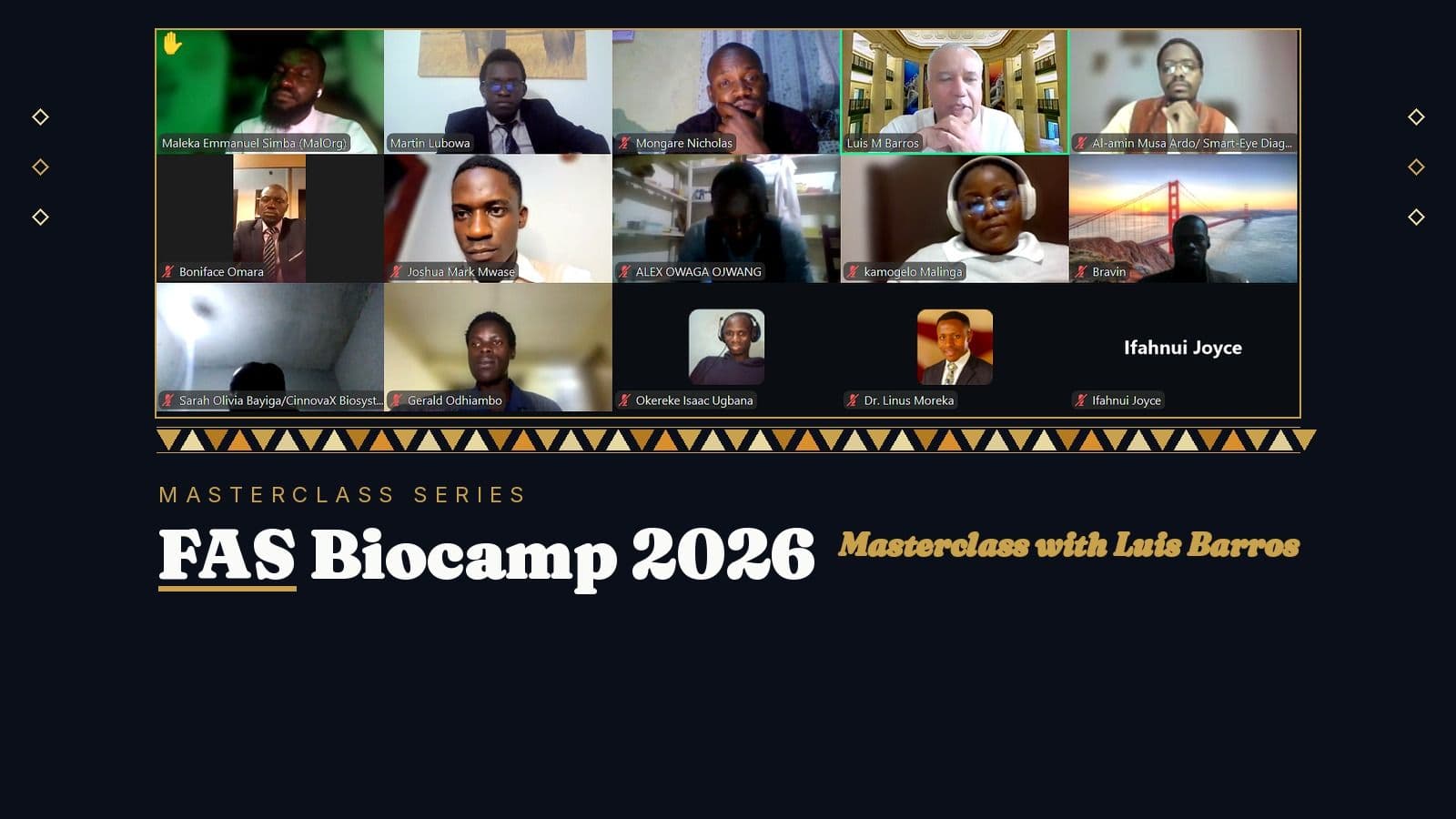
That is the question Luis Barros came to answer. On 22 June, Barros joined the 2026 cohort for a single, open masterclass on venture development in resource-constrained environments, and he treated the constraint not as an apology but as the starting point.
Barros is a lecturer in the Global Economics and Management group at the MIT Sloan School of Management, where he leads healthcare and life sciences work for MIT PATH. Through Leading Business Ventures, the advisory firm he heads, he has spent more than twenty-five years helping startups, investors, corporations, and public institutions get science to market, across six continents and more than forty-five countries. His work has centered on commercialization readiness, venture strategy, and the non-dilutive and alternative financing that early companies in emerging markets so often depend on. Earlier in his career he helped architect the Massachusetts Life Sciences Center and served on the compliance staff of the U.S. Securities and Exchange Commission. He holds degrees from the University of Pennsylvania, MIT Sloan, and the University of Massachusetts Amherst.

Luis Barros speaking with the cohort at the 2026 FAS Biocamp.
Barros built the evening around a single reframe. In a resource-constrained market, scarcity is not the obstacle to building a company. It is the design constraint that makes the company good. He walked the cohort through what that means in practice: reading the real economics of the continent they are building in, proving what he calls commercialization readiness before the capital arrives, and financing a venture through the messy combination of grants, partnerships, and private investment rather than one clean round.
The through-line was discipline. Constraints, in his telling, force founders to prioritize the most important problem first, to sequence progress against real milestones, and to build solutions that survive contact with the conditions they will actually operate in, not the ones a pitch deck assumes. He took the cohort’s questions directly, answering from operating experience rather than theory, including how to combine non-dilutive funding, partnerships, and private capital without becoming dependent on any single source.
For the founders, it reframed the ground they were standing on. “What resonated with me most was your discussion on how to build ventures not despite constraints, but because of them, using limitations as a forcing function for creativity, efficiency, and disciplined prioritization,” said Kamogelo Malinga, a 2026 Biocamp founder from South Africa. “It completely reframed how I think about resource-scarce settings, moving from a narrative of scarcity to one of strategic resilience.”
For others it changed how they would run the very next experiment. “Your framing of venture development as a design constraint, not a limitation, that capital scarcity forces discipline, stayed with me,” said Sarah Bayiga, a 2026 Biocamp founder from Uganda who is building CinnovaX. “I will apply it directly: instead of waiting for the perfect lab or the full budget, I will design experiments that fit the resources I actually have.”
It is a discipline the cohort is already living, from Smart-Eye Diagnostics running its field pilots in Nigeria, to Phytfrex Biotech pursuing malaria and other neglected diseases in Kenya, to GeneHus building genomics tools in Ghana. Barros gave them a way to name it. The constraint is not the reason the venture is hard. It is the reason it will be built to last, and built at home.