Africa holds an extraordinary share of the world’s plant biodiversity, and much of its traditional medicine is built on that chemistry. But turning a medicinal plant into a therapeutic you can make at scale is a different problem entirely. You cannot harvest your way to a drug supply, and the extraction infrastructure that would let you isolate a compound industrially mostly does not exist on the continent. For a founder sitting on a promising natural compound, the gap between the plant and the product can look impassable. At the 2026 FAS Biocamp, Jing-Ke Weng showed the cohort a way across it.
Weng has spent his career learning to read, and then rebuild, the chemistry that plants invent. His central message to the founders was almost counterintuitive: you do not have to find the plant to make its molecule. If you understand the metabolic pathway a plant uses to build a compound, you can reconstruct that pathway inside a microbe like yeast or bacteria and brew the molecule in a fermenter. The plant becomes a blueprint, not a supply chain.
Jing-Ke Weng is the inaugural Director of the Institute for Plant-Human Interface at Northeastern University, where he is a Professor of Chemistry and Chemical Biology and of Bioengineering. For a decade before that he was a professor of biology at MIT and a member of the Whitehead Institute for Biomedical Research, after training as a Pioneer Postdoctoral Fellow at the Salk Institute and the Howard Hughes Medical Institute. He earned his undergraduate degree in biotechnology from Zhejiang University and his doctorate in biochemistry from Purdue. His laboratory studies how plants evolved their staggering chemical creativity, and how that biochemistry can be harnessed for human health. He is also a founder: he co-founded DoubleRainbow Biosciences, a company that uses synthetic biology to reconstruct plant natural products and turn them into therapeutics and nutraceuticals. He came to the cohort as both a scientist and a builder who has carried this idea from the bench to the market.
Across the session, Weng walked the founders through how a plant’s specialized metabolism actually works, and how modern synthetic biology lets you rebuild it deliberately. Nature, he argued, is an enormous and largely unread library of useful molecules, refined over hundreds of millions of years of evolution. The opportunity is not only to discover those molecules but to understand the genetic pathways that produce them well enough to reconstruct them in a host organism. Framed that way, a compound is no longer something you extract and hope to source. It is a system you can program and scale.
He was candid about how that work actually unfolds. Candidate genes often do not do what the hypothesis predicts, he told the founders, and the real discovery usually hides in that surprise rather than in the tidy result. The discipline is to follow the anomaly instead of forcing the data to fit the model. It is a lesson that reaches well beyond a metabolism lab. For a founder, the experiment that defies expectation is not a failure but a signal to look closer.
Weng also spoke as someone who has built a company, not only a research program. He was measured about artificial intelligence, which he sees as a genuinely powerful new direction for the life sciences but one that can quietly erode parts of a venture’s value chain if it is adopted without thought. The task, he suggested, is to navigate that disruption so that what you build still lines up with your beachhead market. And he returned to a founder’s oldest truth: assemble the right team for the right job, and remember that a founder’s real learning comes through building.

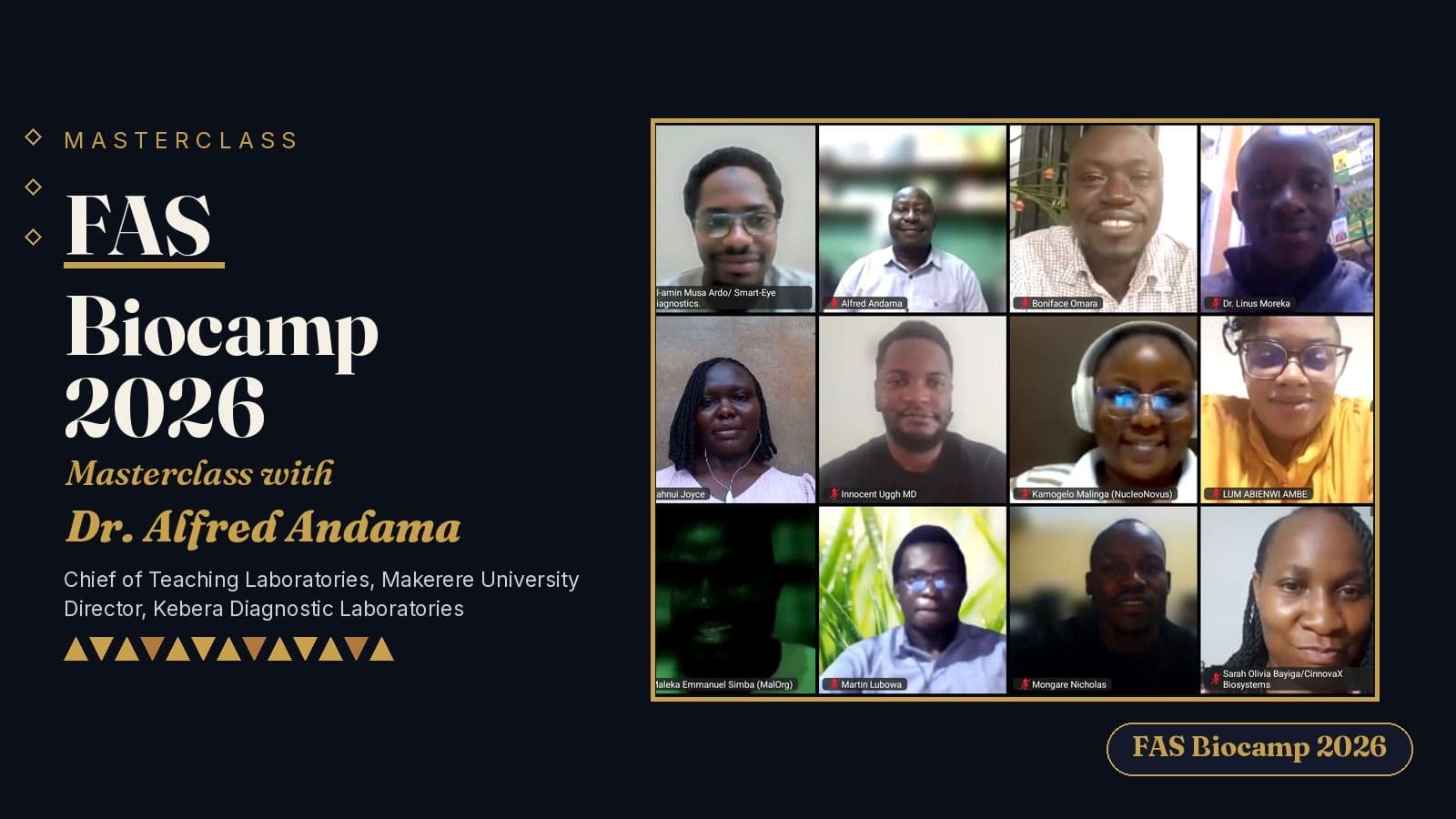
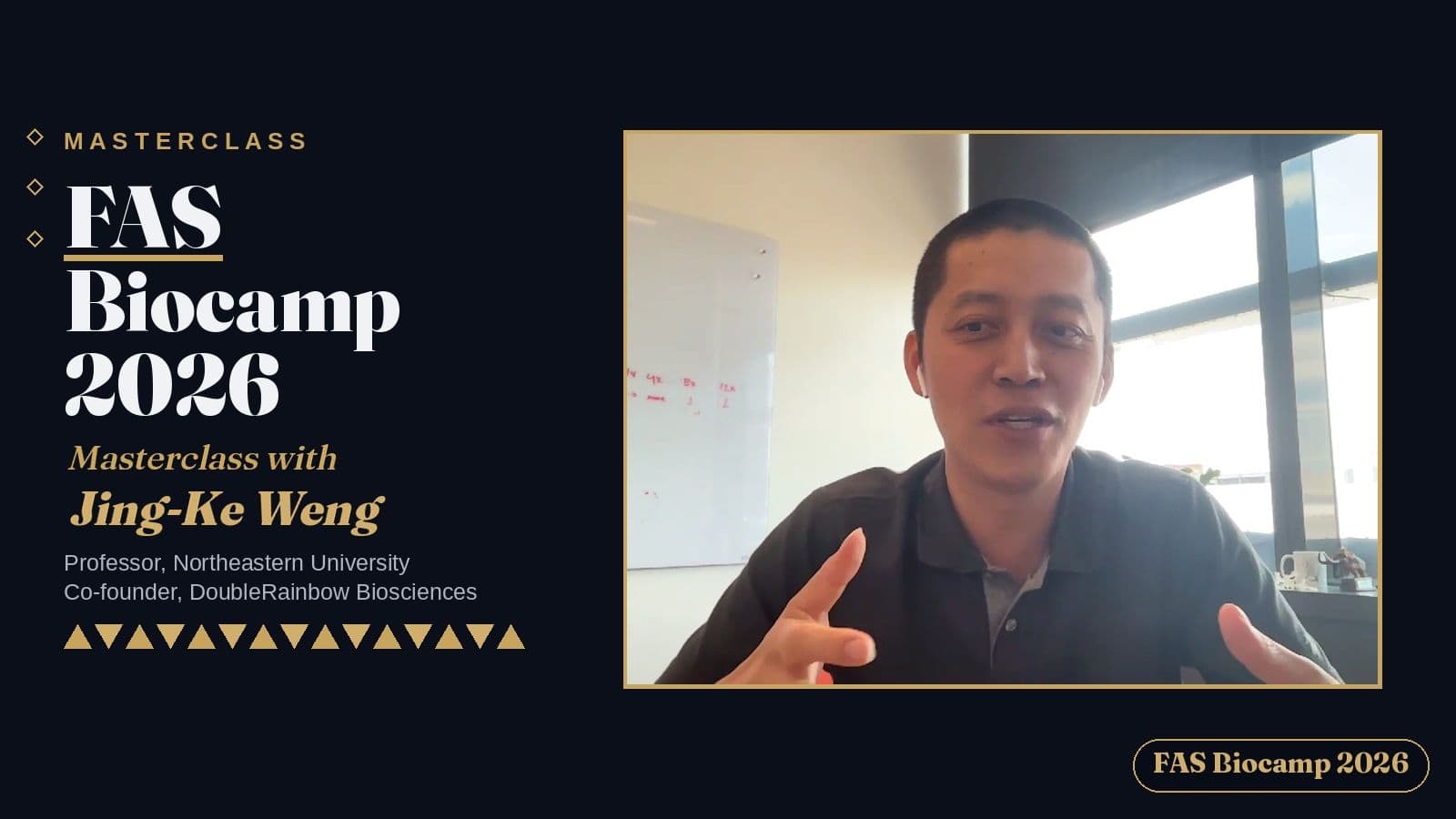
The 2026 FAS Biocamp cohort during Jing-Ke Weng’s 25 June masterclass on plant metabolism and reconstructing biosynthetic pathways.
For the founders, that reframing changed what they saw when they looked at the biodiversity around them. “The idea that shifted my thinking was that the genetic pathways for bioactive compounds are not just discovery targets, they are programmable systems,” said Rozy Abiero, a founder from Kenya. “You showed us that you do not have to find the plant, you can build the pathway. For a continent with immense biodiversity but limited extraction infrastructure, that is a different kind of opportunity. It is not about finding more plants. It is about learning to program them.”
Others heard an invitation to treat the continent’s plants as a starting point for real ventures. “Your talk made me see our continent’s extraordinary plant biodiversity not simply as a natural resource, but as a foundation for discovering the next generation of therapeutics,” said Boniface Omara, a founder from Uganda building Mara Biosciences. “It inspired me to think more broadly about how we could combine computational biology with Africa’s rich medicinal plant diversity to develop therapies for diseases that disproportionately affect our continent. Thank you for expanding my perspective on what is possible.”
And for those weighing how to build responsibly, his method offered a blueprint. “Your approach to rebuilding complex plant chemistry inside hosts like yeast or bacteria was incredibly eye-opening,” said Al-Amin Musa Ardo, a founder from Nigeria building Smart-Eye Diagnostics. “It showed how we can responsibly unlock the therapeutic potential of local biodiversity and traditional medicine without depleting natural ecosystems. Your work is a true inspiration for how modern synthetic biology can bridge the gap between regional natural assets and scalable, sustainable biotechnology.”
That is the work the FAS Biocamp exists to support. The founders in that room are building the diagnostics and therapeutics their communities need, often starting from the plants and traditional knowledge around them. Jing-Ke Weng’s message was that the distance between that biodiversity and a real product is not as wide as it looks. Understand the chemistry deeply enough, and you can rebuild it, scale it, and keep the value at home.