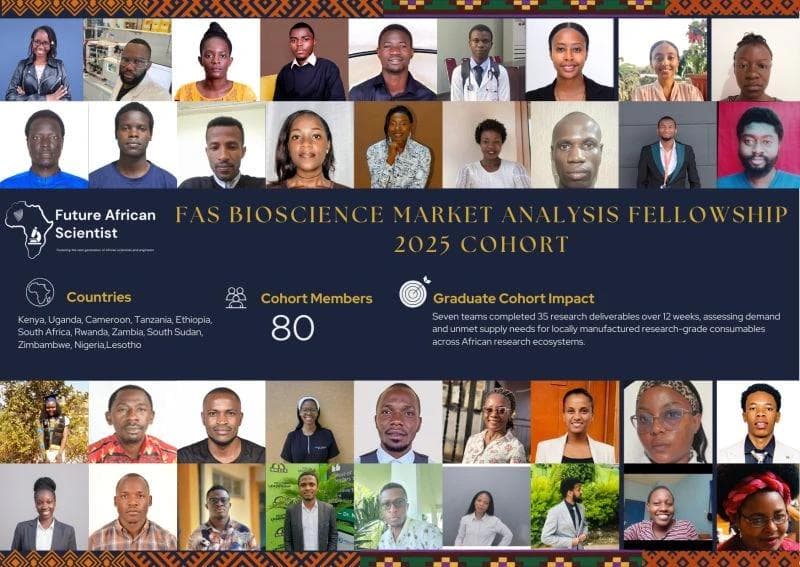
Can locally manufactured research-grade consumables reliably meet the needs of laboratories across African research, clinical, and diagnostic settings? That question guided the 2025 FAS Bioscience Market Analysis Fellowship, which has now concluded.
A defined objective
The fellowship set out with a clear goal: to assess the market for locally manufactured research-grade consumables. Fellows identified 20–50 operational startups and 20–50 laboratories using laboratory reagents, evaluated demand through website reviews, surveys, and secondary data, and analysed the market to surface unmet supply needs.
Seven teams, 35 research outputs
Over twelve weeks, fellows worked in seven teams to deliver 35 research outputs. Each group completed a secondary market report, conducted primary data collection through stakeholder interviews, and produced SWOT and PEST analyses. They developed market-gap and TAM/SAM/SOM assessments and compiled data-backed customer segmentation spreadsheets.
Together, this work mapped supply actors and end users while surfacing the gaps between demand and availability across diverse research ecosystems. In total: 80 fellows, 12 African countries, seven teams, and 35 research deliverables.
Insight for those building the ecosystem
Participants brought local context, analytical rigour, and collaboration to a shared inquiry — generating insights relevant to investors, policymakers, manufacturers, and the institutions working to strengthen bioscience infrastructure across the continent.
Why it matters
As the fellowship concludes, the work offers a clearer picture of where local manufacturing can have the greatest impact, and where further coordination is needed. Building Africa's own supply of research-grade consumables is part of the larger goal FAS is built around — health and wealth, built at home.
With thanks
The Bioscience Market Analysis Fellowship was run with WinWin Scientific and professionals from Washington University in St. Louis. Our thanks to Thi Nguyen and Esse Evbuomwan of WinWin Scientific for leading it, and to the fellows and partners who made the work possible.
Interested in learning more about the analysis, engaging with the fellows, or understanding the next steps? Reach out or follow Future African Scientist.