Turning Africa's scientists into founders is the whole point of the FAS Biocamp, and it takes more than good science to get there. It takes people with firsthand exposure to life sciences entrepreneurship, and who are willing to sit with the next generation and show them how it is done. This year, one of those people was Kevin Yang.
Yang is a physician and strategist who has spent his career where science meets business and technology. He has founded a healthcare startup, helped guide drug launches inside some of the world's largest pharmaceutical companies, and advised biopharma teams as a consultant. He trained as a doctor and later earned an MBA from MIT Sloan. Over the course of the Biocamp, he brought all of that experience to the cohort.

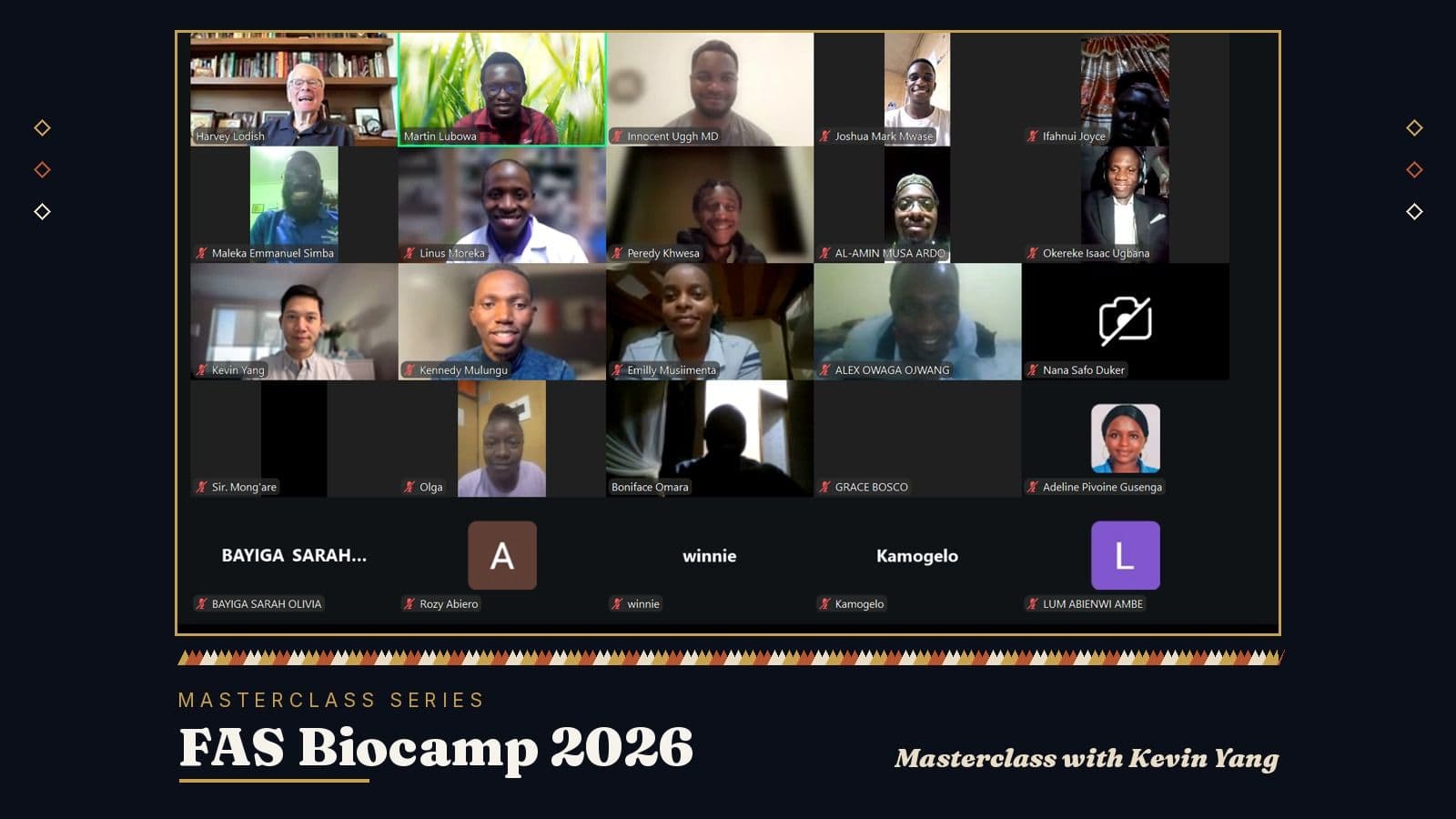
Kevin Yang with the FAS Biocamp 2026 cohort and Professor Harvey Lodish.
His central lesson was one the founders heard in different forms throughout the program. Strong science, on its own, is never enough. What carries a venture is evidence, execution, and the ability to tell a story that moves investors, partners, and customers to act. He taught it plainly, and he was honest about how often good ideas stall when founders skip those steps.
For the founders, the change was personal. “Kevin's emphasis on using data and real-world signals, not assumptions, to guide development and commercialization decisions changed how I think about my own venture,” said Chelangat Eliud, a 2026 Biocamp founder from Uganda. “He pushed me to focus on structured customer feedback, repeat purchases, and unit economics rather than product improvement alone. He made complex biopharma strategy feel genuinely actionable.”
Others described a similar shift in how they see their work. “Kevin's teaching completely changed how I look at biotech innovation,” said Gerald Odhiambo, a founder from Kenya. “I learned to think about building a venture not just from the scientific side, but from the business and the investor perspective.”

The cohort together at one of the final sessions of the 2026 Biocamp.
That is what the Biocamp is built to do. It puts scientists who are ready to build in the same room as the people who have built before, so the next wave of biotech companies can be founded, and grown, at home.