Most of the founders in the 2026 FAS Biocamp cohort are standing at the same unmarked crossing. They have a science degree from an African university, a research question that will not let go, and a quiet suspicion that the work could become more than a paper. What they rarely have is proof that anyone has crossed it from where they stand, with the same laboratory, the same constraints, and the same funding questions.
Dr. Alfred Andama has. On 21 July he spent an evening with the cohort telling the story of how he got here, and the founders heard what they had been waiting for: a path that begins at the bench, runs through African institutions, and ends in a company.
Dr. Andama is the Chief of Teaching Laboratories in the Department of Internal Medicine at Makerere University College of Health Sciences in Kampala. He began as a biomedical laboratory technologist, then built his career in Uganda, earning his bachelor’s, master’s, and PhD in microbiology at Makerere. His research tests whether new tuberculosis diagnostics actually work, through accuracy studies and usability assessments that decide whether a promising device survives contact with a real clinic. He is also the director of Kebera Diagnostic Laboratories, a company that grew directly out of his doctoral project.
That last detail is the one the founders kept returning to. Kebera did not come from a business plan competition or a move abroad. It came from a research question that outgrew the thesis, built patiently inside a university while Dr. Andama kept teaching and kept doing the science. He talked about starting with what you have rather than waiting for better conditions, about the value of building credibility through careful local validation before chasing scale, and about the habits of a founder who is trusted: a transparent culture, an honest account of the vision, and enough visible work that the right people can find you.

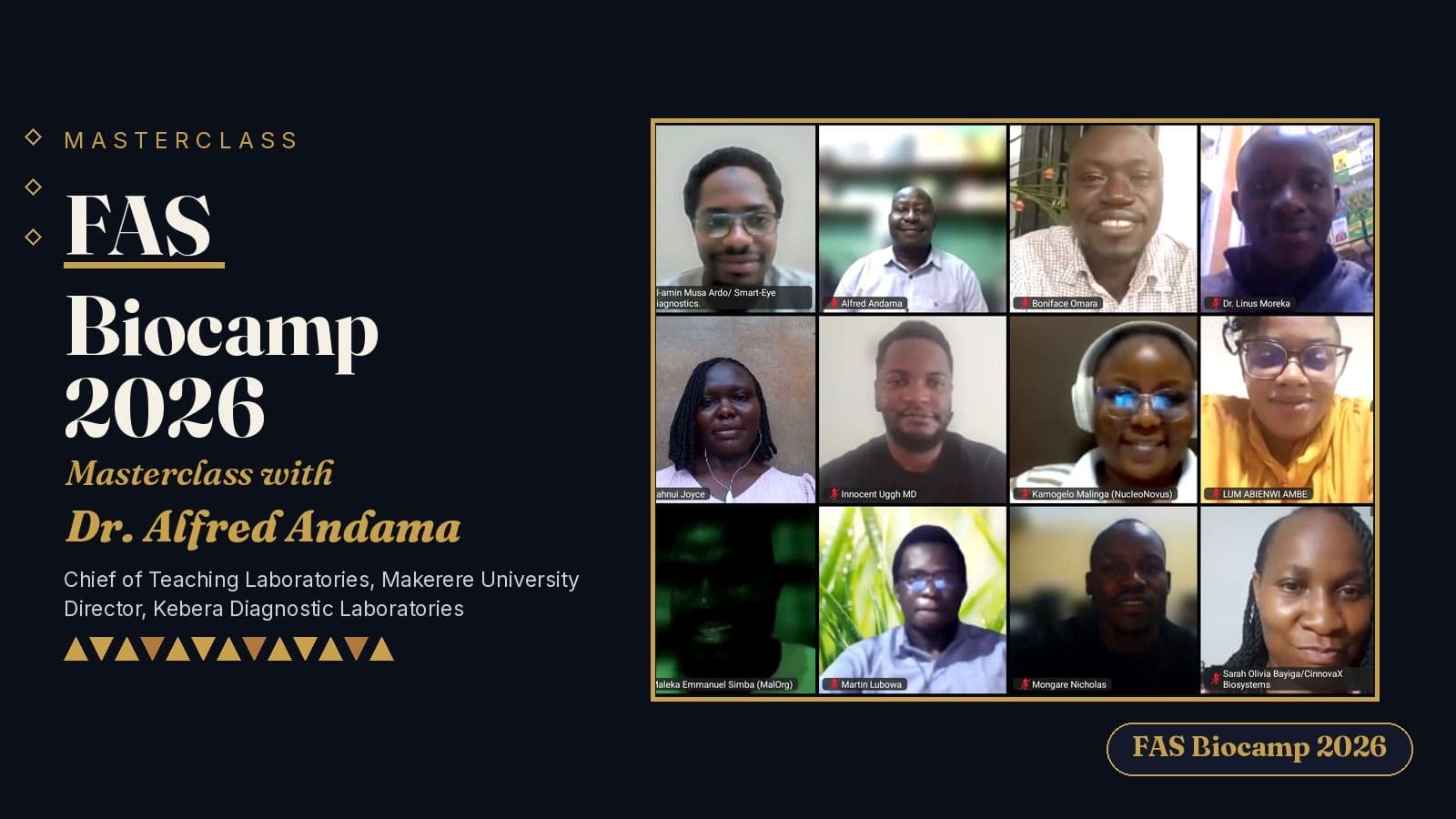
Founders of the 2026 FAS Biocamp cohort during Dr. Alfred Andama’s 21 July masterclass on how he got from the teaching laboratory to Kebera.
For many in the cohort, the first thing that landed was the origin story itself. “I will carry with me the quiet fact that you built Kebera Diagnostic Laboratories out of your PhD project, not out of a business plan competition, but out of a research question that refused to stay in a paper,” said Bayiga Sarah Olivia, a founder from Uganda building CinnovaX Biosystems. “Seeing that a career in science here can lead to something real, tangible, and local, without needing to go elsewhere, was a gift.”
Others took away lessons about how to lead. “Your insights on building a transparent culture completely changed my perspective on leadership,” said Mwase Joshua Mark, a founder from Uganda building KaaraGen. “I now see that honestly communicating my vision is vital to recruiting a supportive team.”
For Winnie Wambugu, a founder from Kenya building Everipe, it was a reframing of the map. “Your insight on building credibility through rigorous local validation before attempting commercial scale completely reframed how I view our regulatory and field trial roadmap,” she said. “Operating within our regional context is not a limitation, but a foundational strength.”
And Linus Moreka, a founder from Kenya building DxAMR, put the whole evening in one line. “I came into this programme thinking the distance between where I am today and a functioning company was mostly about funding and technology,” he said. “Your story shifted that. The distance is mostly about starting, and staying.”
That is the work the FAS Biocamp exists to support. The founders in that room are turning African science into African ventures, and Dr. Andama showed them that the road runs through the laboratories, universities, and communities they already know. Start where you are, build the evidence at home, and stay.