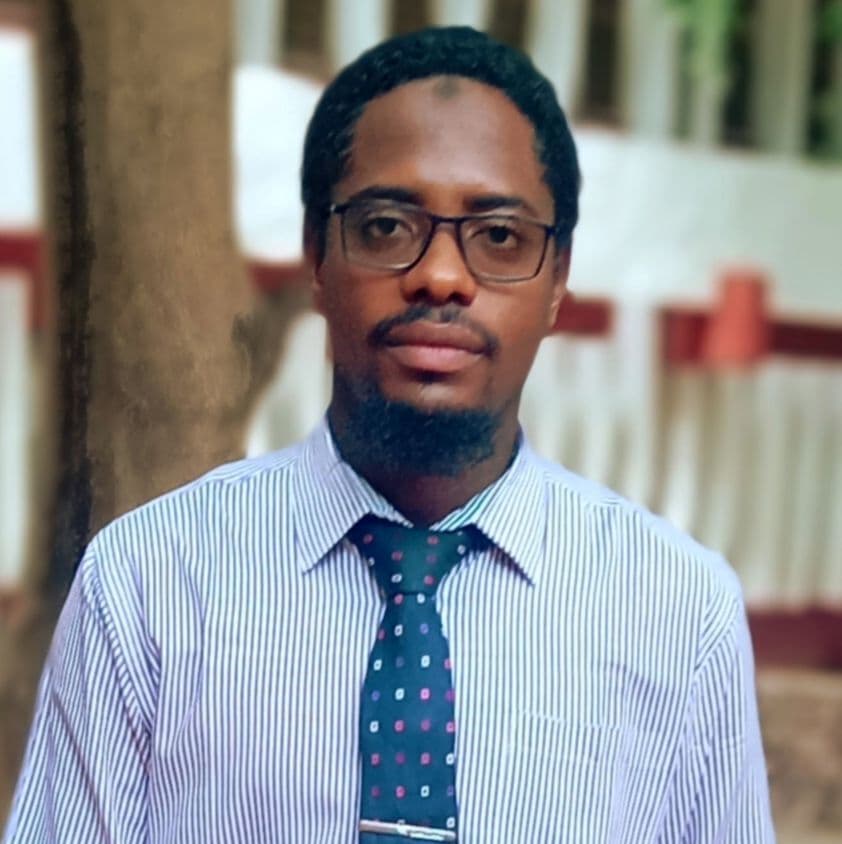
“The opportunity for wealth, excellence, and influence comes from solving problems that people suffer from.”
Al-Amin Musa Ardo, founder of Smart Eye Diagnostics, FAS Biocamp Fellow 2026, Nigeria
Behind the swing at the back of the playground, there was a small patch of ground Al-Amin Musa Ardo kept for himself. That was where he took apart used cans and wired them to batteries to make his own fans, and where, as a curious child who was always “trying to find the limit,” he kept whatever he was building that week. He didn’t know it yet, but that patch of ground was the first version of a habit that would define his career: given a problem and whatever was lying around, build something that works.
He had planned, like most people around him, to finish school and get a job. That plan didn’t survive contact with the job market. “You can’t just have a job anymore,” he says now. “There are no more jobs. If you’re going to be successful, it’s because you’re able to solve a problem people have.” The realization that wealth comes from solving problems, not from a title, is what pushed him off the path he’d expected to walk.
The idea itself arrived in an undergraduate biomedical sciences classroom, in a lecture on entrepreneurship, with his classmates and lecturer around him. The class was being taught to think about how science could make money, not just publish papers. Something about that discussion stuck. Al-Amin started sketching a plan right there, and it later became the subject of his undergraduate project.
What he sketched became Smart Eye Diagnostics: an AI system that upgrades the microscopes medical laboratories already own, instead of asking them to buy new ones. A lab scientist clips a simple optical adapter onto the eyepiece of their existing microscope, aligns a phone to it, and the AI reads the slide alongside them, helping them examine samples faster, more consistently, and with less fatigue over a long shift. No new microscope. No new lab. Just an adapter and a phone on the equipment that’s already there.
The first person outside his circle to take it seriously was someone he sent his plans to for review. That person read through the documents and told him plainly that if it was done right, it could be transformative. It was enough to make Al-Amin sit down and start planning how to actually build it. Not everyone agreed. One person experienced in building and training AI models told him it wasn’t possible, because he doubted Al-Amin could ever get the data needed to train it. Al-Amin tried to bring him onto the team anyway. “When you have someone with a bit of skepticism on your team, it also helps,” he says.
Al-Amin had been following FAS on LinkedIn and sitting quietly in its WhatsApp group for two to three years before he applied. What almost stopped him wasn’t the programme; it was him. His idea wasn’t clear yet, and he assumed no one would take it, or him, seriously. The 2026 Biocamp is his first FAS programme, and he describes it as the first one that has challenged him “not just scientifically, but psychologically and mentally.” It upended everything he thought he knew about science and about making money.

Al-Amin at the bench, running samples under the microscope.
On the day he arrived, Smart Eye Diagnostics was an idea. Since then, he has secured a letter of intent from Precision Biomedicals, who were convinced enough by the idea to commit to helping him build it, and he has met with the African Center for Neglected Tropical Diseases and Forensic Biotechnology, Ahmadu Bello University Zaria, where talks toward a formal partnership are underway, though nothing is signed yet. Two names shaped how he works now: Kevin, who pushed him to make his idea sharper and more direct instead of vague, and Professor Harvey, whose classes convinced him there is no ceiling on what one person can build. The FAS network is still active in his life day to day. Joshua Mark Mwase helped him deploy his website, and in exchange he helped Joshua sharpen some of his documents. He also helped Mongare Nicholas shape his venture around a stronger starting point and better future prospects, and helped Kamogelo Malinga find an easier starting point for her own. Without FAS, he’s blunt about where he’d be: “My idea would just still be an idea. I would still be stuck in the idea stage, thinking alone.”
He was wrong about one big thing early on: he assumed building a camera dedicated to a microscope eyepiece would be simple, a straightforward hardware add-on. It wasn’t. Getting the optics and the AI pipeline to actually work cost him, in his words, “a lot of sleepless nights and some headaches,” and months of research he hadn’t budgeted for. One person he already sees the effect on is a lab partner he’s built the platform alongside, who Al-Amin says has become “more aware of research” through the process and has since gone on to study parasitology himself. Al-Amin’s larger hope is to eventually reach every microscopist working in a lab across Africa.
The next person he’s looking to bring on is technical: a co-founder who can lead the machine-learning side of the product, someone strong in programming and AI. In return, he’s offering a seat at the table from day one: the experience of building a startup from its very first steps, together. He has already started passing that forward. He mentored Dogara Ishaya, teaching him how to open a LinkedIn account, connect with professionals, and see the diagnostics field differently. The advice he gave to students from his own university was about building a community, starting at the university and then expanding to other universities, and about making themselves properly visible on LinkedIn so they can connect with other students, early-career scientists and experienced professionals who support both their professional and personal growth. That advice led to Borderless Scientists. He has also mentored many secondary-school students, several of whom have now applied to universities to study Medical Laboratory Science and related sciences, bringing growth and development to their community, their country and Africa at large.
More on Smart Eye Diagnostics: smarteyediagnostics.com