For a scientist, the hardest gap is rarely in the lab. It is the one between a real discovery and the money it takes to turn that discovery into a company. Most founders only ever hear one side of that conversation. At the 2026 FAS Biocamp, the cohort heard both.
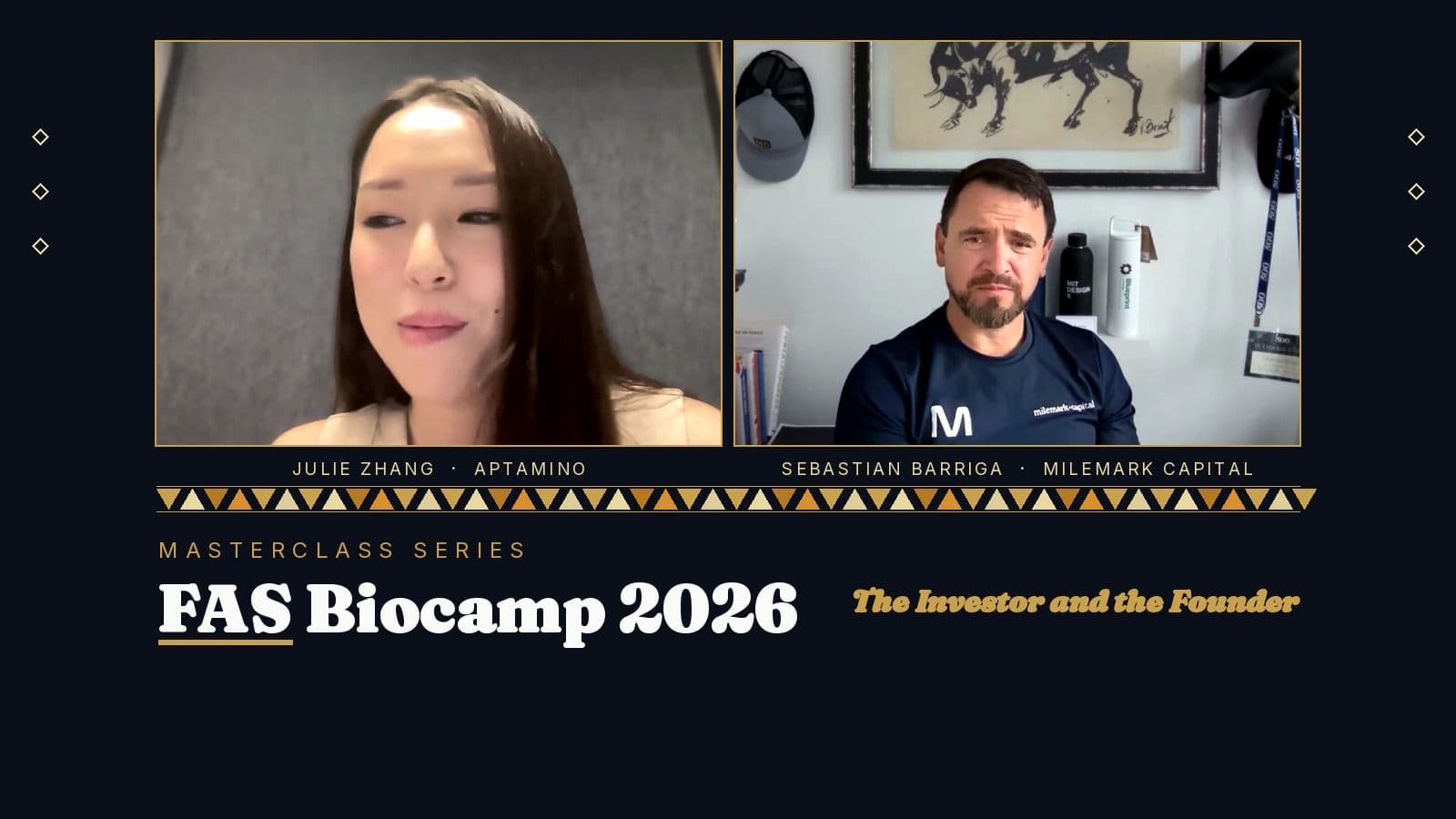
Sebastian Barriga came to give the investor’s view, and he asked Julie Zhang to give the founder’s. One evaluates ventures for a living. The other has built one. Together they walked the cohort through how venture capital really works, and what it actually feels like to raise it.
Sebastian is the founder and general partner of milemark capital, where he invests in and mentors early-stage founders coming out of MIT and Harvard who are building companies on deep science and AI. He mentors across some of the most competitive programs in the ecosystem, from Techstars Boston to MIT delta v and The Engine’s Blueprint, and has backed more than thirty startups. Before venture, he built private equity and corporate board experience with The Carlyle Group, served as interim chief financial officer of a public company during a turnaround, and spent over a decade in investment banking. He sits on the advisory council of the MIT Visiting Fellows Program and mentors at MIT Sloan.
Julie Zhang is the chief executive and co-founder of Aptamino, a Cambridge biotech she started to solve one of medicine’s stubborn problems. Many of the most powerful drugs, biologics like antibodies and peptides, can only be given by injection. Aptamino uses protein design and AI to turn those injectable medicines into pills, work that could make advanced treatment far more practical in exactly the resource-constrained settings many FAS founders are building for. The company is backed by Fifty Years, a firm that backs founders tackling the world’s biggest problems. Zhang joined the session to tell the founders what raising that kind of money actually took.

Julie Zhang and Sebastian Barriga (top row) with the cohort during the 2026 Biocamp session.
Sebastian was blunt about what investors are really buying. Not the technology on its own, but the evidence around it: a real problem, a credible plan to reduce risk one milestone at a time, and a founder the investor can believe will execute. He was candid about the failures as well as the wins, and about how different kinds of capital, from private equity to early-stage venture, carry different expectations, timelines, and kinds of pressure.
Zhang answered from the other chair. She told the founders what the fundraising road actually felt like: the string of noes before a yes, the discipline of keeping the science honest while investors push for speed, and the quiet importance of choosing a co-founder and investors who can go the distance. Raising money, in her telling, was not the finish line. It was the entry ticket, and the hard part came after.
For the founders, the investor’s view rearranged their priorities. “I used to think all money was the same. Now I understand that the right investor at the right stage matters more than the cheque size,” said Rozy Abiero, a 2026 Biocamp founder from Kenya. Kamogelo Malinga, a founder from South Africa building NucleoNovus, took away something more personal. “Your point about VCs investing in people, not just pitch decks, stuck with me. I need to focus less on perfecting my slides and more on showing who I am and why I am the one to execute this.”
Zhang’s honesty landed just as hard. “I thought raising money was the hardest part. It turns out it is the easy part compared to keeping the science honest while you scale,” said Sarah Bayiga, a founder from Uganda building CinnovaX. “That reframed how I think about fundraising. It is not the finish line, it is the entry ticket.” For Peredy Khwesa, a founder from Rwanda, it clarified the work ahead. “I need to make the science investable by showing not only why it matters, but how each next step reduces uncertainty and brings the work closer to the people who need it.”

The 2026 Biocamp cohort on the call. Julie Zhang and Sebastian Barriga (second row) led the session on venture capital.
That is the FAS Biocamp’s wager in one evening. The cohort does not only need capital. It needs to understand the people and the discipline behind it, from both sides of the table. Founders who can raise money without losing the science are how Africa’s discoveries become ventures that last, and stay, at home.