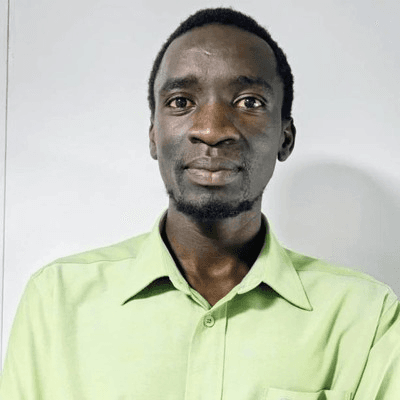

“The future of bioentrepreneurship in Africa isn’t just going to happen. It’s being built by what you and I choose to do right now.”
Mwase Joshua Mark, founder of KaaraGen, FAS Biocamp Fellow 2026, Uganda
In primary six, a teacher named Mr. Moses told Mwase Joshua Mark’s class that Uganda had only one neurosurgeon anyone could name, and that the country was short of specialists of every kind. Mark decided then that he would study science and become a neurosurgeon himself. He is not one today, and he says so plainly. But the plan stayed the same, he says; only the path changed. It led him into biotechnology, which opened his mind further than he expected.
The idea for KaaraGen came while he was finishing his Bachelor of Science in Biotechnology. A course unit on microbe interactions covered RNA interference, including virus-induced gene silencing and spray-induced gene silencing. Around the same time, an academic research internship at Uganda’s national crops research institute at Namulonge showed him how molecular tools are used to diagnose crop disease and measure how severe it is. He began to wonder what modern biotechnology could change about how plant disease is managed in the field, and he went back to his course notes.
KaaraGen helps farmers protect their cassava from cassava brown streak disease using RNA-based biotechnology, so that the starch industry in Uganda and East Africa stops losing supply to a virus. What Mark is building is a sprayable, soakable “vaccine” that silences the virus. The customer he has in mind is the managing director of a starch factory, who has to reject part of the cassava that arrives, then struggles to deliver the quantity of high-quality starch his contracted buyer expects. Mark pictures him sitting under an umbrella, hand on his chin, frustrated, and thinking about putting in more money just to catch up.
Testing the idea has been a step-by-step job. A connection of one of his advisors was the first to say yes, on whether the science holds in theory. Then Mark took it to customers, and one gave him a partial yes on whether it would work in practice. The sharpest lesson came from that conversation. Double-stranded RNA sprayed on its own, without a carrier, breaks down quickly under the tropical sun and washes off in the rain. That pushed KaaraGen toward a delivery system built on layered double hydroxide nanoparticles, known as BioClay.
Mark first heard about FAS about three years ago, from Martin Lubowa, his former high school classmate and the founder of FAS. In his first year of university he joined his first FAS course, Biotechnology and Business, taught by Professor Harvey Lodish. The lectures covered mRNA vaccines, adeno-associated viruses in gene therapy, and ex vivo gene therapy for sickle cell disease and beta thalassemia. He almost stayed away, because he saw himself as a science person, not a business one. He is glad he did not.
On the first day of the 2026 Biocamp, KaaraGen was a sketch of an idea. When he sat down for this interview in late August, it had a website, an advisory board, customers it had reached out to, and primary market research that the team keeps refining. Letters of intent were still to be secured.
He says the daily reading summaries changed how he works. They were so detailed, starting with Disciplined Entrepreneurship, that he went and bought the books to study them further. A lesson from Joshua Boger stayed with him too: be humble about your talents, but not about your aspirations. And he now treats the company’s mission as a filter. Plans can fail, he says, but the mission holds and shapes every decision the team makes.
Mark is still waiting to graduate. When he joined FAS, many of the people around him already had master’s degrees and PhDs, and he doubted that his idea belonged in the same room. What he learned is that it is not about the level you have reached. It is about whether you can execute. Without FAS, he says, his venture would not exist.
What KaaraGen needs now is a specialist. The bottleneck is the formulation of the BioClay carrier, which calls for a materials scientist or nanotechnologist. KaaraGen is offering that person a place on the founding team, as co-founder and nanotechnology lead.
More on KaaraGen: kaaragen.com