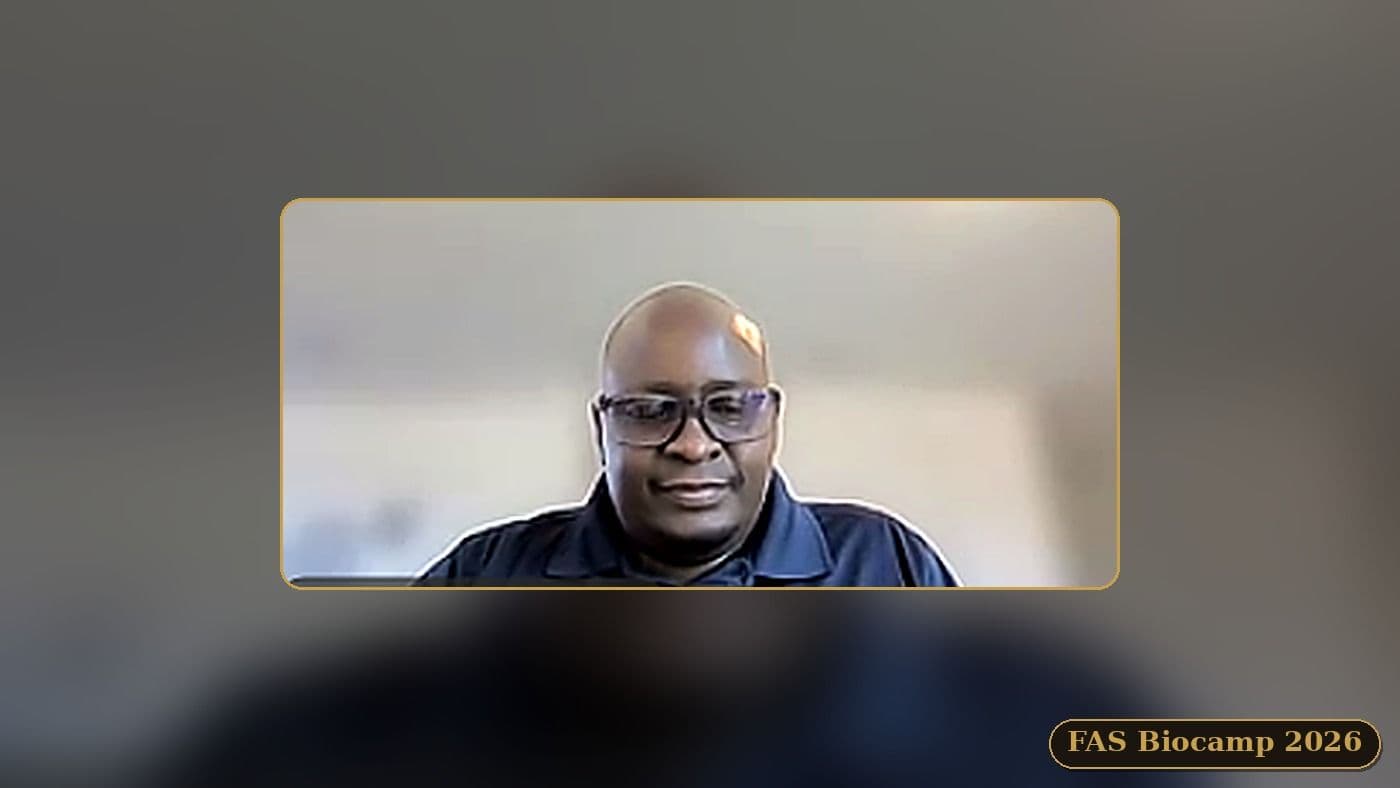
For a founder building a diagnostic, the hardest test is rarely in the lab. It is the clinic with no technician, the farm with no veterinarian, the district with no cold chain. A test that works perfectly on the bench can still fail the moment it meets the real system it was built to serve. At the 2026 FAS Biocamp, Emmanuel Okello spent an evening on exactly that gap.
Okello came to the cohort not with a lecture on molecules, but with a way of seeing. Animal health, human health, and the health of the environment we all share, he argued, are not three separate problems. They are one system. You cannot fix one part of it while ignoring the others, and any serious solution to a disease, a diagnostic, or the slow crisis of drug resistance has to hold all three at once.
Okello trained as a veterinarian at Makerere University in Uganda, then earned a master’s in molecular biology in Leuven and a doctorate in bio-engineering sciences in Brussels. Today he is an associate professor at the University of California, Davis, School of Veterinary Medicine, where he leads the Livestock Antimicrobial Stewardship Program and its work on the responsible use of antibiotics across the state’s dairy, beef, small-ruminant, pig, and poultry systems. His research spans the drivers of drug use and resistance in animal agriculture, the discovery of novel antimicrobials and alternatives to antibiotics, and rapid diagnostics for livestock disease, and he has served on the national and international panels shaping how the world responds to resistance, from a California state stewardship work group to a National Academies committee and the Africa One Health University Network.
Across the evening, Okello kept returning to a single, bracing idea. Antimicrobial resistance is not a simple bug-and-drug problem to be solved with one more antibiotic. It is a systems failure. The answer, he told the founders, is not a new drug but the discipline to use the ones we have correctly, and to build the diagnostics, the workflows, and the incentives that make correct use possible in the first place.
He was honest about the infrastructure gaps African founders face, the wet-lab and preclinical capacity that is often simply not there yet, and just as honest that he had faced the same walls himself. His answer was collaboration: the partnerships with universities, laboratories, and industry that let a young venture do serious science long before it can afford to own the whole stack. And he pushed the cohort past the seduction of the technology itself toward the harder question of adoption. Who actually uses this? Does it fit the clinic, the farm, the hospital as they really are, and not as a lab imagines them to be?

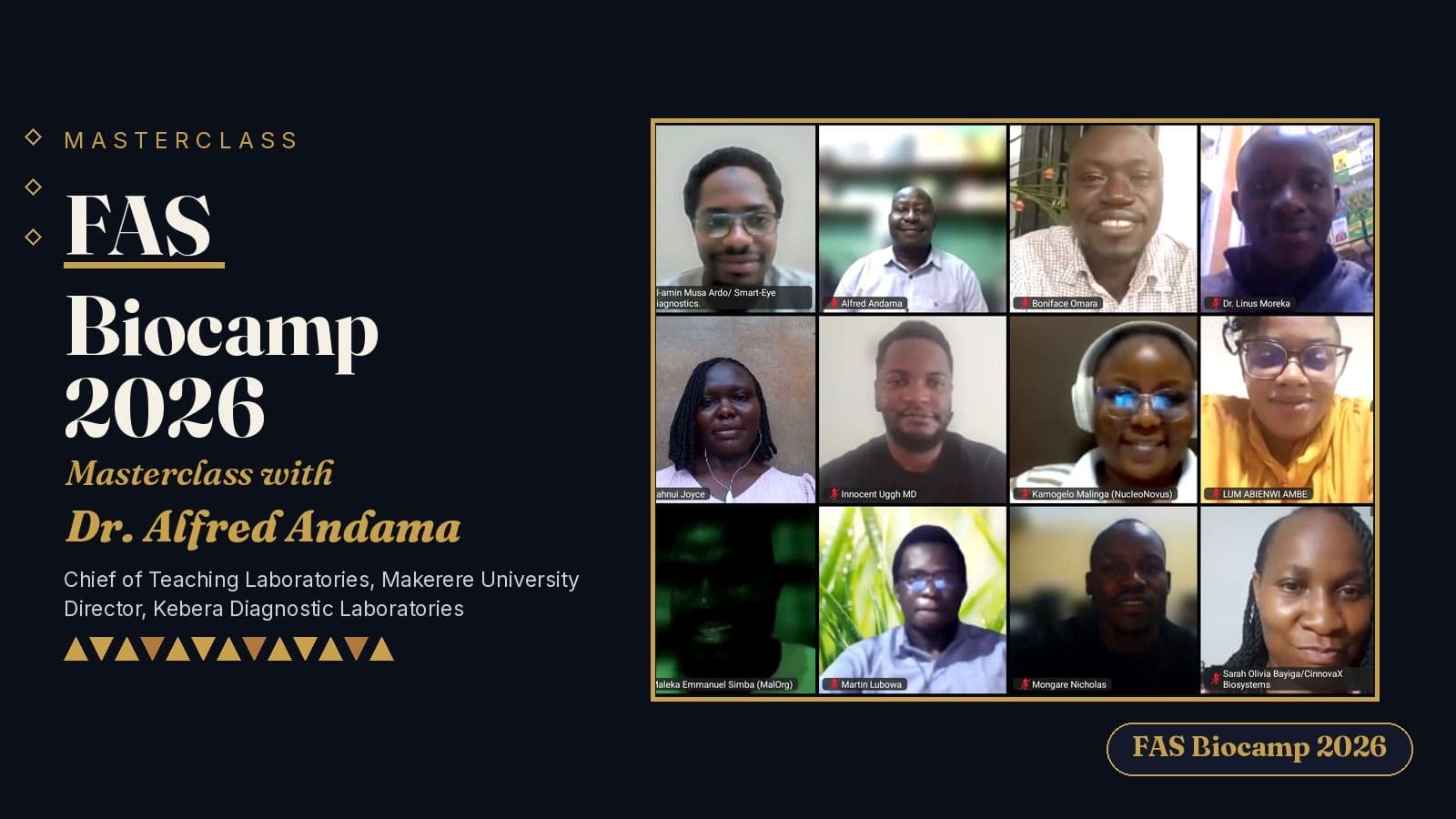
The 2026 FAS Biocamp cohort with Emmanuel Okello (top left) during the 9 June session.
For the founders, the reframe rearranged the work ahead. “I will stop designing tests for ideal labs and start designing for places with no vet at all,” said Rozy Abiero, a 2026 Biocamp founder from Kenya, “always asking what human and environmental problem the test also touches.”
The systems view of resistance landed just as hard. “The answer is not a new antibiotic. The answer is using the ones we have correctly,” said Sarah Bayiga, a founder from Uganda building CinnovaX, recalling the line that stayed with her. “That changed how I think about my own work. I will not design a product in isolation. I will design it to fit inside the real workflow, the real constraints, and the real failures of the system it is meant to serve.”
For others it sharpened a specific product decision. “This reshaped how I view ZuriHemo Diagnostics,” said Mongare Nicholas, a founder from Kenya. “I will focus more on hospital workflows and design solutions that fit into them.”
That is the FAS Biocamp’s wager. Africa’s health challenges will not be answered by science that only works in the lab. They will be answered by founders who design for the system as it is, and build ventures that fit the clinics, the farms, and the communities they come from.